
Remote Interpreting vs Onsite for Global Events
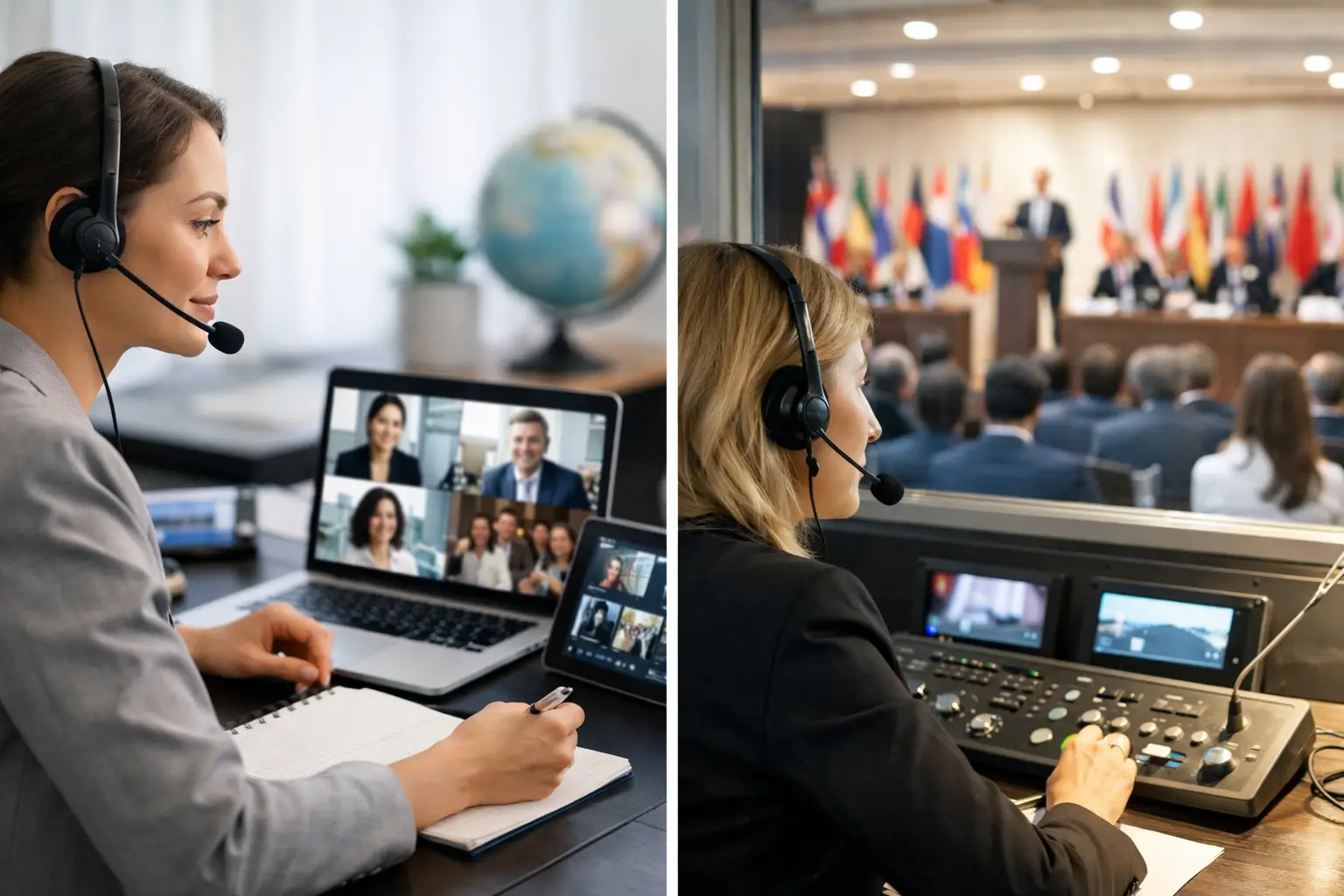
A board briefing begins in Singapore at 9:00 a.m., product leaders join from Bangkok and Jakarta, and a regional sales team follows from Hong Kong. The question is not whether language access is needed. It is whether remote interpreting vs onsite delivery will give every participant the clarity, confidence, and control required for the meeting to succeed.
For enterprise events, interpreting is an operational decision, not an event add-on. The right model affects participation, message consistency, meeting security, budget discipline, and the ability to bring the right subject-matter linguists into the room. Neither option is universally better. The strongest choice depends on the event format, audience profile, technical environment, and consequences of misunderstanding.
Remote Interpreting vs Onsite: The Core Difference
Onsite interpreting places professional interpreters at the physical venue. Depending on the format, they may work from an interpretation booth with dedicated audio equipment or provide consecutive interpretation alongside speakers and participants. This model has long been the standard for conferences, executive sessions, factory visits, negotiations, and high-touch stakeholder meetings.
Remote interpreting delivers the same linguistic function through a secure virtual platform. Interpreters work from a professional remote environment and provide simultaneous or consecutive interpretation to attendees joining online, often through a browser, mobile device, conference platform, or dedicated audio channel. It can also support hybrid meetings, where some participants are in a venue and others join remotely.
The difference is not simply location. Onsite delivery prioritizes direct human presence and controlled room dynamics. Remote delivery prioritizes reach, flexibility, and access to specialized language talent without travel constraints. For global organizations, the best decision often starts by identifying which of those priorities carries greater business risk.
When Onsite Interpreting Creates the Stronger Experience
Onsite interpreting is often the better choice when communication relies heavily on physical context. A manufacturing walkthrough, medical device demonstration, government delegation visit, or high-stakes negotiation can involve visual cues, side conversations, documents being reviewed in real time, and fast changes in the room. An interpreter who is physically present can follow those dynamics more naturally.
It also supports events where participant experience is central. Senior leadership summits, investor meetings, large conferences, and formal product launches may benefit from the confidence that comes with an interpreter booth, professional audio distribution, and a linguist who is fully embedded in the venue operation. For audiences unfamiliar with virtual meeting tools, onsite channels can reduce the burden of joining, selecting a language feed, and resolving individual device issues.
The trade-off is cost and logistics. Travel, accommodations, local transport, venue access, equipment, security clearance, and scheduling must all be managed. For multilingual events, the cost can rise quickly as more language pairs and interpreters are added. These are justified investments when the meeting demands premium in-room engagement, but they should be planned well in advance.
Situations that favor an onsite model
Onsite delivery is particularly well suited to confidential executive discussions, formal negotiations, regulatory or legal meetings, technical site visits, and conferences where most attendees are gathered in one location. It is also valuable when the venue already has professional interpretation infrastructure and a reliable technical team.
For highly specialized subject matter, physical presence can improve preparation and coordination with speakers. Interpreters can review materials, observe demonstrations, and align with event staff before the session begins. This is especially relevant in healthcare, life sciences, aerospace, finance, and engineering, where precise terminology is inseparable from business and compliance risk.
Where Remote Interpreting Delivers More Value
Remote interpreting is designed for organizations that need language access across borders without making geography the limiting factor. It enables an enterprise to convene dispersed employees, partners, customers, or stakeholders while engaging qualified interpreters from a wider talent pool. That can be decisive for less common languages, specialized industries, or tight event timelines.
It also offers a more scalable model for recurring communications. Consider quarterly town halls, virtual instructor-led training, regional sales enablement sessions, employee onboarding, or customer webinars. Rather than arranging travel for every session, organizations can establish a repeatable remote workflow with pre-event checks, language channels, speaker briefings, and participant instructions.
Cost efficiency is a meaningful advantage, but it should not be the only reason to choose remote delivery. The larger benefit is agility. A remote model can reduce lead times, accommodate speakers in multiple time zones, and make multilingual access available for events that would not have justified the cost of onsite coverage.
The technology requirement is non-negotiable
Remote interpreting depends on reliable technology and disciplined event management. Weak internet connections, poor speaker microphones, platform limitations, or unclear attendee instructions can undermine even the most experienced interpreter. A virtual meeting that treats interpretation as a last-minute setting change creates avoidable risk.
Enterprise teams should confirm the platform’s language-channel capabilities, audio quality, participant capacity, access controls, recording rules, and technical support model. Interpreters also need advance access to agendas, slide decks, terminology, speaker notes, and any pre-recorded media. Technical rehearsal is not optional for high-visibility events. It verifies audio routing, handoffs between speakers, language selection, backup connections, and escalation procedures before the audience arrives.
How to Evaluate Cost Beyond the Quote
Comparing interpreter rates alone does not produce an accurate budget. Onsite costs may include travel time, transportation, accommodations, per diems, equipment rental, booth installation, audio technicians, and venue coordination. Remote projects may require platform licensing, technical production, participant support, backup connectivity, and additional preparation for speakers who are unfamiliar with multilingual virtual delivery.
The more useful question is: what level of communication failure can the event tolerate? A short internal update may work well with a standardized remote setup. A merger discussion, safety briefing, compliance workshop, or investor presentation needs a model that protects comprehension at every point.
Organizations should also account for interpreter team requirements. Simultaneous interpreting is cognitively demanding, and longer sessions typically require two interpreters per language pair so they can rotate and maintain accuracy. Attempts to reduce staffing below professional standards can affect quality, particularly when presentations include technical terminology, rapid delivery, or interactive discussion.
Confidentiality, Quality, and Preparation
Both remote and onsite interpreting can meet high confidentiality expectations when they are managed properly. The delivery model matters less than the safeguards around it: vetted interpreters, confidentiality agreements, secure platform access, appropriate data handling, restricted recording permissions, and a clear process for sharing meeting materials.
Quality begins before the event. Interpreters need context on the organization, audience, objectives, terminology, acronyms, speaker profiles, and sensitive topics. A global workforce briefing may use internal product names and policy language that have no standard equivalent in another language. A financial results presentation may require careful treatment of figures, legal qualifications, and forward-looking statements. Preparation enables interpreters to deliver meaning accurately rather than merely translating words at speed.
This is where an enterprise language partner adds value. A managed service model can coordinate language pairs, interpreter credentials, technical requirements, terminology preparation, scheduling across time zones, and quality assurance under a single accountable process. For recurring programs, that consistency compounds over time.
Choosing the Right Model for Hybrid Events
Hybrid events require the most deliberate planning because they combine in-room and virtual communication risks. A room-based audience may need onsite interpretation while remote participants require language channels through the event platform. Alternatively, interpreters may work remotely while supporting attendees at the venue and online.
The decision should be based on where the audience is, not just where the speakers are. If a major portion of participants is in a physical venue, onsite interpreters and professional audio infrastructure may create the most dependable experience. If attendees are broadly distributed across markets, a remote or mixed model can provide better coverage and reduce complexity.
Do not assume that a standard video meeting setup can support a hybrid multilingual event. Room microphones must capture every speaker clearly, remote participants need a way to ask questions without disrupting language feeds, and interpreters need clean audio without echoes or competing sound. A production plan should define who controls the platform, how questions are routed, and what happens if a speaker’s connection fails.
A Practical Decision Framework
Before selecting a format, assess the event against four operational factors: audience distribution, communication stakes, technical readiness, and language complexity. An event with a dispersed audience, predictable agenda, and tested virtual platform is a strong remote candidate. An event involving sensitive negotiation, live demonstrations, or concentrated in-person attendance may warrant onsite support.
Then consider whether the event is a one-time moment or part of a larger communications program. A company rolling out multilingual training across regions may benefit from a remote model that can be repeated and integrated with translated learning materials, voice-over, and localized communications. A flagship annual conference may justify a tailored onsite operation with a dedicated interpreting team.
The objective is not to choose the newest format or the lowest-cost option. It is to create conditions in which every participant can understand, contribute, and act on the message with confidence. With experienced interpreters, disciplined preparation, and the right technical design, Verztec can help organizations make that decision according to the realities of each event, market, and audience.